Overview
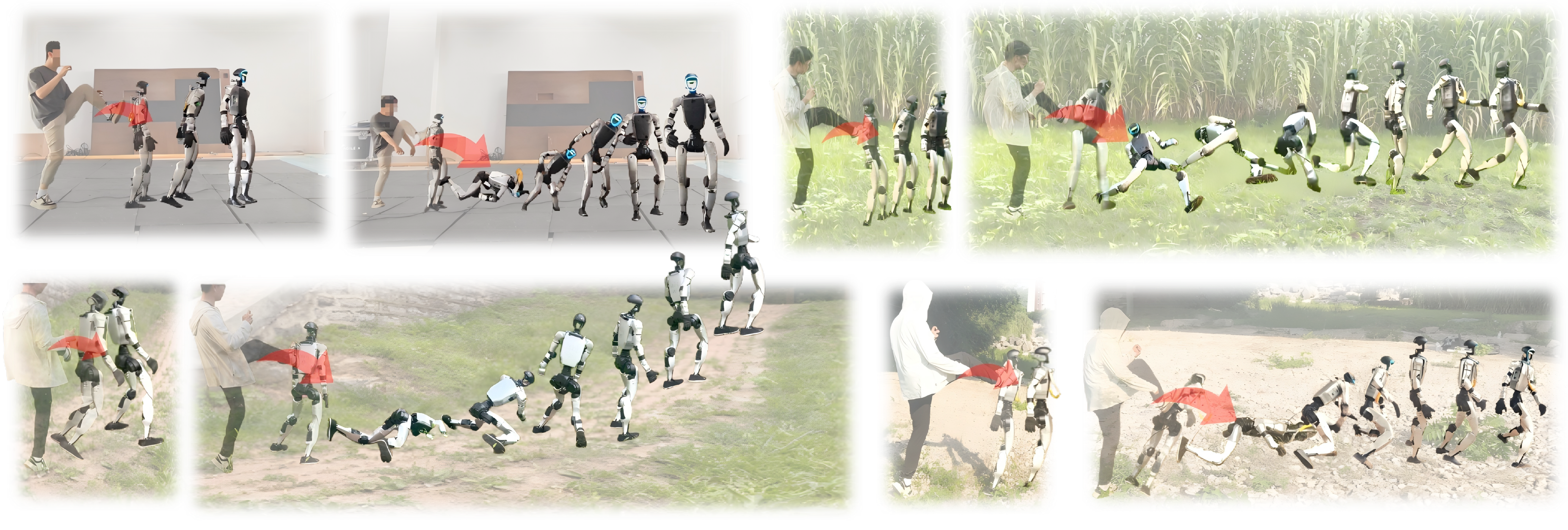
Reliable fall recovery is essential for humanoid robots operating autonomously in unstructured environments. Recent learning-based studies have advanced both standing-up across diverse terrain conditions and unified recovery–locomotion control. However, these capabilities have largely been investigated as separate settings, leaving sustained command-following locomotion after recovery on heterogeneous terrains comparatively less explored. We present UniReLo (Learning a Unified Humanoid Policy from Fall Recovery to Locomotion across Diverse Terrains), a unified framework for fall recovery and subsequent velocity-commanded locomotion across heterogeneous terrains. Terrain-Conditioned Stable-Region Guidance evaluates recovery feasibility using terrain-relative support geometry and complementary stability factors, encouraging support configurations suitable for subsequent locomotion rather than relying on upright posture alone. Continuously Gated Multi-Scale Motion Priors use quantified recovery progress to coordinate frame-, sequence-, and gait-level adversarial supervision throughout recovery, transition, and locomotion. Simulation comparisons and controlled ablations on flat ground, gravel, and 10° and 15° slopes demonstrate improved recovery success, support stability, and recovery-to-locomotion transition continuity over the evaluated baselines. Hardware experiments using a 29-DoF Unitree G1 humanoid cover the same terrain categories and additionally include outdoor grass, which is absent from simulation training. The results demonstrate sustained command-following locomotion after recovery, disturbance resistance during walking, and autonomous recovery from fall-inducing perturbations, while indicating the cross-terrain generalization of the learned policy.
Under external kicks and fall-inducing conditions, UniReLo either absorbs a mild disturbance while maintaining stable locomotion (Robustness), or recovers from a strong perturbation or fallen posture and seamlessly resumes walking (Recovery-to-Locomotion) — across indoor, grass, and slope terrains.
The same UniReLo policy rises from a wide range of initial fallen postures using a single deployable policy. Guided by Terrain-Pose Plasticity-Aware Initialization, the policy learns to stand up from supine, prone, side-lying, and curled configurations.
Zero-shot MuJoCo simulation counterparts of the real-world experiments above, covering locomotion across terrains, robustness/recovery-to-locomotion under perturbations, and multi-posture recovery.
MuJoCo simulation of the same external-kick conditions.
Stand Up from Supine
Stand Up from Prone
Stand Up from Side-Lying
Stand Up from Curled
@article{xu2026unirelo,
  title   = {{UniReLo}: Learning a Unified Humanoid Policy from Fall Recovery to Locomotion across Diverse Terrains},
  author  = {Xu, Xiaoyu and Chen, Zhiming and Zhao, Yuenan and Zhang, Xiang and Song, Ran and Zhang, Wei},
  journal = {arXiv preprint arXiv:2606.08922},
  year    = {2026}
}